
What this document is
The enterprise standard for deciding what the Consortium charges for, who pays, through which legal entity, and what portion is deliberately subsidised.
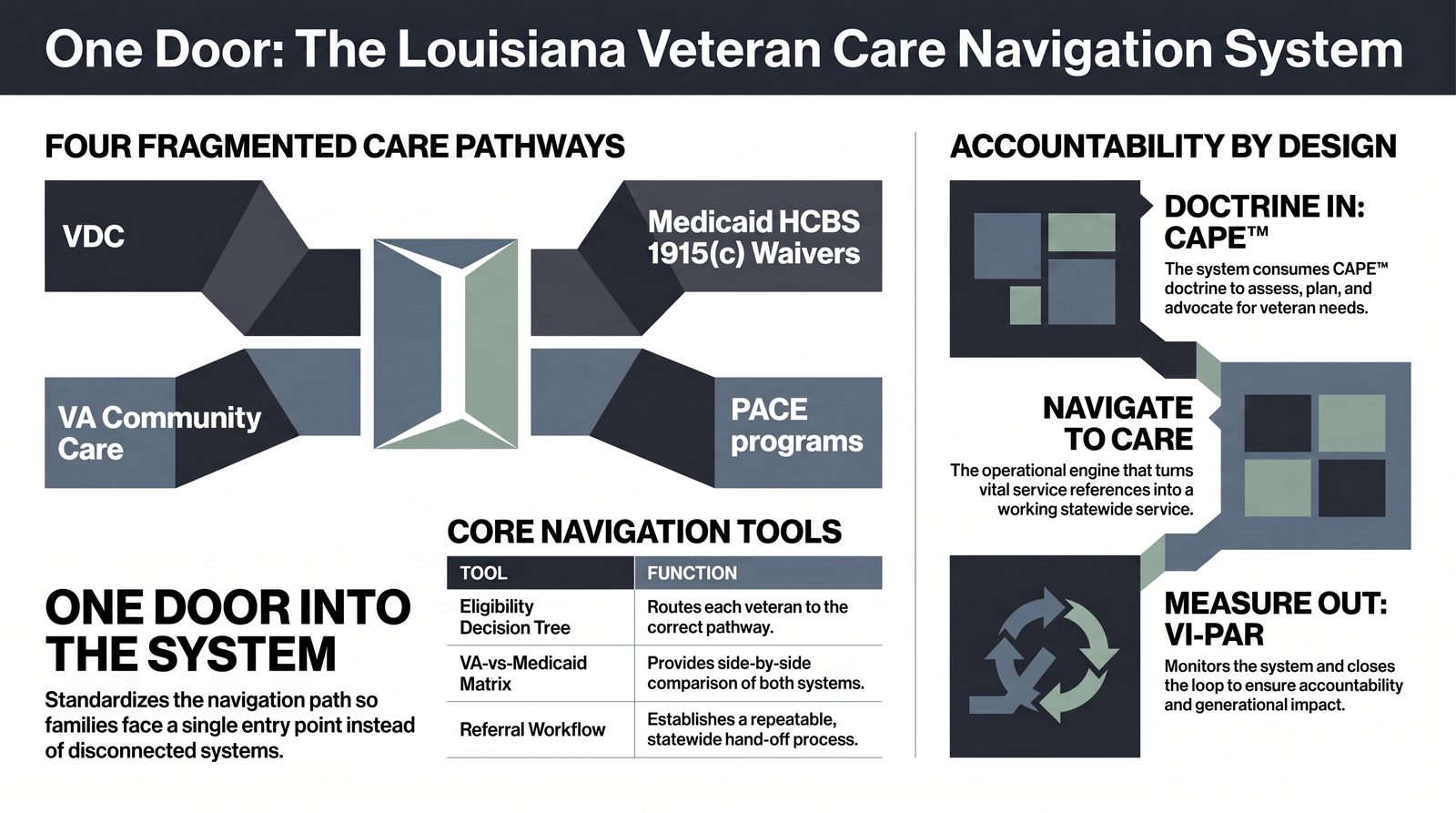
The problem it solves: veterans and caregivers face The problem it solves: fee-for-service is usually adopted as a tactic — charge for something, close the gap. Done that way it drifts the mission, diverts staff and prices out the people the organisation exists to serve.. The framework standardizes the path so families face one door, not many.
It is designed to become a Treated as a portfolio instead, earned revenue becomes a governed capability: five distinct revenue layers, each with its own entity, its own pricing logic and its own subsidy rule. and a repeatable reference for the navigation team, with VI-PAR™ monitoring closing the loop.
Charging is not selling out
A 501(c)(3) may charge fees. The IRS recognises fee-generating programme service, and income from an activity substantially related to an exempt purpose is generally not unrelated business income.
The real test is not whether money changes hands. It is whether the activity contributes importantly to the exempt purpose, whether the organisation still operates primarily for that purpose, and whether any private benefit is incidental.
So the question is never "should we charge?" It is "which entity should earn this, from whom, at what price, and what portion do we intend to absorb?"
The customer, the beneficiary and the payer are three different people
This is the move that resolves the affordability problem without abandoning earned revenue.
A rural Veteran can receive a service at no cost while the revenue arrives from a VA or community contract, a hospital community-benefit agreement, a philanthropic sponsor, a parish government contract, an employer, a bank CRA partner or an institutional subscription.
Once the payer is decoupled from the beneficiary, a service can be free at the point of delivery and still fully funded. Most nonprofit fee debates stall because they assume those two must be the same person.
Five layers of revenue
Philanthropic — grants, donations and sponsorships that finance populations where charging the beneficiary is inappropriate.
Contracted mission revenue — government, healthcare, institutional and corporate payers who fund LCDC to deliver mission services to eligible people.
Mission-related programme fees — training, education, credentialing and incubator participation, with scholarship or sliding-scale provision wherever access is mission-critical.
Commercial social enterprise — consulting, licensing, staffing, subscriptions, analytics and implementation services, housed principally in EEC or the appropriate affiliate.
Intellectual property and recurring revenue — the controlled monetisation of VEBOK™, VEI™, EFIRS™, VE-OSMF™, VI-PAR™, curricula, certification and toolkits. This is the layer that converts work already being done into a repeatable asset rather than selling executive hours.
Which entity earns what
Assessment, navigation, housing education and disaster education sit in LCDC — free, subsidised or sliding-scale, as mission programme.
Organisational training, technical assistance, consulting, subscriptions, staffing intermediation, analytics and implementation services sit in EEC or the designated affiliate, at contract or market rate.
Boot Camps, credentialing, the culinary incubator and M-TOC™ deployment are hybrids — charitable when the beneficiary is the payer’s object, commercial when an institution is buying capacity.
Two controls hold this together. LCDC must not subsidise commercial activity by accident. EEC must not extract charitable value without documented fair-value, related-party, conflict-of-interest and cost-allocation review.
Price from cost, never from the competitor
A fee shall not be set because a competitor charges that amount. Market price is evidence of what a buyer will pay; it is not evidence that the activity is sustainable.
Every proposed service establishes financial full cost, then economic sustainability cost, and only then asks: who pays, what portion, through which entity, with what subsidy.
Four outcomes follow. If the customer can pay sustainable full cost, charge it. If they cannot but a third party can, sponsor it. If mission requires partial absorption, subsidise it deliberately and record it. If demand exists outside the charitable mission entirely, price it at market through the affiliate.
The line that governs all of it
Earned revenue shall expand mission capacity without converting inability to pay into inability to receive mission-critical services.
That single sentence decides most cases. It permits vigorous commercial activity in the affiliate, permits real fees where access is not at stake, and forbids a pricing decision that puts a Veteran outside a service they need.
The governing chain: EFIRS™ feasibility → EFCPAS™ full cost → entity and tax review → pricing → subsidy determination → contract and billing → VI-PAR™ performance → BIBS™ Board oversight.
The The revenue control layer for — the most build-ready operational system in the library. It consumes CAPE™ and the Vital Services reference and turns them into a working statewide service.
This anchor is a draft until leadership shapes it. As you read:
- Which services should never carry a participant fee, under any circumstance?
- Which of our capabilities could an institution be paying for today?
- Where should commercial work sit — LCDC, EEC, or a new affiliate?